Uncategorized

Wikinews interviews Frank Moore, independent candidate for US President

Saturday, March 1, 2008

While nearly all coverage of the 2008 Presidential election has focused on the Democratic and Republican candidates, the race for the White House also includes independents and third party candidates. These parties represent a variety of views that may not be acknowledged by the major party platforms.

Wikinews has impartially reached out to these candidates, throughout the campaign. We now interview independent Presidential candidate Frank Moore, a performance artist.

Retrieved from “https://en.wikinews.org/w/index.php?title=Wikinews_interviews_Frank_Moore,_independent_candidate_for_US_President&oldid=2185149”
Uncategorized

George Bush: Rescue plan will get through

Tuesday, September 30, 2008

George W. Bush vowed to get the USD 700 billion economic rescue plan through congress in a statement to the media made today.

“Yesterday, the House of Representatives voted on a financial rescue plan that had been negotiated by Congressional leaders of both parties and my administration,” Bush reminded the audience. “Unfortunately, the measure was defeated by a narrow margin. I’m disappointed by the outcome, but I assure our citizens and citizens around the world that this is not the end of the legislative process.”

“Producing legislation is complicated, and it can be contentious. It matters little what a path a bill takes to become law,” he continued. “We’re at a critical moment for our economy, and we need legislation that decisively address the troubled assets now clogging the financial system, helps lenders resume the flow of credit to consumers and businesses, and allows the American economy to get moving again.”

Market Data

23:45, 30 September, 2008 (UTC)
  • DJIA
  • 10.850,70 485,21 4,68%
  • Nasdaq
  • 2.082,33 98,60 4.97%
  • S&P 500
  • 1.166,36 59,97 5,42%
  • S&P TSX
  • 11.752,90 467,83 4.15%
  • IPC
  • 24.888,90 933,23 3,90%
  • Merval
  • 1.598,170 52.720 3,41%
  • Bovespa
  • 49.541,27 3,513.21 7,63%
  • FTSE 100
  • 4.902,45 83,68 1,74%
  • DAX
  • 5.831,02 23,94 0,41%
  • CAC 40
  • 4.032,10 78,62 1,99%
  • SMI
  • 6.654,89 154,76 2,38%
  • AEX
  • 331,45 7,90 2,44%
  • BEL20
  • 2.672,20 82,73 3,19%
  • MIBTel
  • 19.512,00 110,00 0,56%
  • IBEX 35
  • 10.987,50 41,80 0,38%
  • All Ordinaries
  • 4.631,30 207,90 4,30%
  • Nikkei
  • 11.259,90 483,75 4,12%
  • Hang Seng
  • 18.016,20 135,53 0,76%
  • SSE Composite
  • 2.293,78 3,72 0,16%

    “I recognize this is a difficult vote for members of Congress. Many of them don’t like the fact that our economy has reached this point, and I understand that. But the reality is that we are in an urgent situation, and the consequences will grow worse each day if we do not act. The dramatic drop in the stock market that we saw yesterday will have a direct impact on the retirement accounts, pension funds, and personal savings of millions of our citizens. And if our nation continues on this course, the economic damage will be painful and lasting.”World and US markets today are up after severe declines yesterday. Most have recovered 30% of their previous losses, meaning that the potential government expenditure was similar to the market losses.

    Bush then said that he knows “many Americans are especially worried about the cost of the legislation.” He then attempted to justify the cost. “The bill the House considered yesterday commits up to 700 billion taxpayer dollars to purchase troubled assets from banks and other financial institutions. That, no question, is a large amount of money. We’re also dealing with a large problem. But to put that in perspective, the drop in the stock market yesterday represented more than a trillion dollars in losses.”

    If passed, the bailout plan would have allowed for the United States government to purchase devalued mortgage backed securities, resulting from the subprime mortgage crisis, from troubled financial institutions. The US Treasury Secretary Henry Paulson said the plan could cost up to $700 billion.

    Retrieved from “https://en.wikinews.org/w/index.php?title=George_Bush:_Rescue_plan_will_get_through&oldid=4492983”
    Civil Excavation And Demolition Services

    Electric Service In Indianapolis Offers Quality Residential And Commercial Services

    byAlma Abell

    When it comes to electrical problems in the home or at a business, it takes more than just having repair skills to deal with them. Electrical problems can be dangerous to repair, even for professionals. Only a trained electrical contractor has the necessary skills to repair any problems that involve working with electricity.

    When lightning storms occur, a sudden surge in power can cause damage to a home’s electrical wiring. An electrical contractor from Burtner Electric Inc will specialize in residential services and can repair or replace burned-out wiring. In addition to dealing with wiring, these electrical contractors can offer services such as installing smoke detectors, ceiling fans, and hooking up backup generators. This is especially useful in areas that see a lot of lightning and wind that cause the homes to lose power because of bad weather.

    Those looking for Electric Service in Indianapolis should consider a company that services both residential homes and commercial businesses. This is because the electricians who work for these companies often have a wide range of experience with fixing electrical problems. When the power goes down in a home, the family is only inconvenienced, but the loss of power at a business can cost thousands of dollars in profit. Hiring a commercial electrician will mean less down time caused by a power failure, as a commercial contractor will have a contingency plan if something happens to the power. This includes installing a generator for a business that has a history of suffering power outages. Electrical contractors who offer an Electric Service in Indianapolis are highly trained and offer high-quality commercial services. This will ensure that major operating systems remain running, even if the power goes out.

    Electrical power is not something that amateurs should handle. Whether it is a homeowner dealing with his or her circuit box or a business owner who has dozens of employees and expensive business equipment to deal with. Professional electrical contractors spend months training in their field to ensure that they understand the wiring of a residence or commercial business. While hiring professional electrical contractors can cost a lot of money, the cost is more than worth it considering what would happen if individuals tried to deal with an electrical problem on their own. Once a professional is hired to handle a job, either with a home or business, their work is guaranteed and the problem will be fixed for good.

    Uncategorized

    US adds 173,000 jobs in August; unemployment rate drops to seven year low

    Monday, September 7, 2015

    The US economy added 173,000 jobs in August, the Bureau of Labor Statistics reported on Friday. The unemployment rate fell from 5.3 to 5.1 percent, the lowest since April 2008.

    Although August job gains were lower than most economists forecast, job growth numbers for June and July were revised upwards by a combined 44,000. Average job gains over the past three months stand at 221,000, compared to March-May’s 189,000 monthly average. Over the past twelve months, job growth has averaged 247,000 per month.

    Average hourly earnings rose 0.3 percent, or 8 cents, marking the largest increase in earnings in seven months. Hourly earnings had risen by 6 cents in July. Wages have risen by 2.2 percent over the past year.

    Job growth in August was primarily concentrated in the health care and social assistance, financial activities, and professional and business services sectors. Those three areas of the economy added a combined 108,000 jobs. Food service and drinking places employment increased by 26,000 over the month, and other economic sectors saw employment hold steady. Manufacturing, on the other hand, saw employment decline by 17,000 in August. A stronger dollar and worldwide economic weakness make US exports less desirable, leading to a flattening in manufacturing employment so far this year after steadily rising in the early years of the US economic recovery.

    The solid overall job gains led analysts to slightly raise expectations for a decision by the Federal Reserve to raise interest rates this month. Investors raised the likelihood of a September rate increase from 26 percent before the jobs report to 30 percent, and stocks dropped by over one percent on Friday. “The payrolls data is certainly good enough to allow for a Fed rate hike in September,” said Deutsche Bank’s head of currency strategy, Alan Ruskin. “The big question is still whether financial market volatility will scupper the plans.”

    “This is the first time the market has looked at a Fed meeting and really has no idea what the Fed is going to do,” said Mark Kepner, a New Jersey equity trader with Themis Trading. “Right now you’re looking at the overall uncertainty and that’s what’s hanging on the market. I don’t think this number in and of itself changes how somebody’s going to vote.”

    Retrieved from “https://en.wikinews.org/w/index.php?title=US_adds_173,000_jobs_in_August;_unemployment_rate_drops_to_seven_year_low&oldid=4150386”
    Uncategorized

    A portrait of Scotland: Gallery reopens after £17.6 million renovation

    Thursday, December 1, 2011

    Today saw Edinburgh’s Scottish National Portrait Gallery reopen following a two-and-a-half-year, £17.6m (US$27.4m) refurbishment. Conversion of office and storage areas sees 60% more space available for displays, and the world’s first purpose-built portrait space is redefining what a portrait gallery should contain; amongst the displays are photographs of the Scottish landscape—portraits of the country itself.

    First opened in 1889, Sir Robert Rowand Anderson’s red sandstone building was gifted to the nation by John Ritchie Findlay, then-owner of The Scotsman newspaper and, a well-known philanthropist. The original cost of construction between 1885 and 1890 is estimated at over 70,000 pounds sterling. Up until 1954, the building also housed the Society of Antiquaries of Scotland who moved to the National Museum of Scotland buildings on Chambers Street. The society’s original meeting table now sits in the public part of the portrait gallery’s library, stared down on by an array of busts and phrenological artefacts.

    Wikinewsie Brian McNeil, with other members of the press, received a guided tour of the gallery last Monday from Deputy Director Nicola Kalinsky. What Kalinsky described as an introduction to the gallery that previously took around 40 minutes, now takes in excess of an hour-and-a-half; with little in the way of questions asked, a more inquisitive tour group could readily take well over two hours to be guided round the seventeen exhibitions currently housed in the gallery.

    A substantial amount of the 60% additional exhibition space is readily apparent on the ground floor. On your left as you enter the gallery is the newly-fitted giant glass elevator, and the “Hot Scots” photographic portrait gallery. This exhibit is intended to show well-known Scottish faces, and will change over time as people fall out of favour, and others take their place. A substantial number of the people now being highlighted are current, and recent, cast members from the BBC’s Doctor Who series.

    The new elevator (left) is the most visible change to improve disabled access to the gallery. Prior to the renovation work, access was only ‘on request’ through staff using a wooden ramp to allow wheelchair access. The entire Queen Street front of the building is reworked with sloping access in addition to the original steps. Whilst a lift was previously available within the gallery, it was only large enough for two people; when used for a wheelchair, it was so cramped that any disabled person’s helper had to go up or down separately from them.

    The gallery expects that the renovation work will see visitor numbers double from before the 2009 closure to around 300,000 each year. As with many of Edinburgh’s museums and galleries, access is free to the public.

    HAVE YOUR SAY
    Would you visit the Portrait Gallery if in Edinburgh? What do you think of efforts to improve accessibility?
    Add or view comments

    The expected significant increase in numbers has seen them working closely with the National Museum of Scotland, which was itself reopened earlier this year after extensive refurbishment work; improved access for wheelchair users also makes it far easier for mothers with baby buggies to access the gallery – prompting more thought on issues as seemingly small as nappy-changing – as Patricia Convery, the gallery’s Head of Press, told Wikinews, a great deal of thought went into the practicalities of increased visitor numbers, and what is needed to ensure as many visitors as possible have a good experience at the gallery.

    Press access to the gallery on Monday was from around 11:30am, with refreshments and an opportunity to catch some of the staff in the Grand Hall before a brief welcoming introduction to the refurbished gallery given by John Leighton, director of the National Galleries of Scotland. Centre-stage in the Grand Hall is a statue of Robert Burns built with funds raised from around the British Empire and intended for his memorial situated on Edinburgh’s Calton Hill.

    The ambulatories surrounding the Grand Hall give the space a cathedral-like feel, with numerous busts – predominantly of Scottish figures – looking in on the tiled floor. The east corner holds a plaque commemorating the gallery’s reopening, next to a far more ornate memorial to John Ritchie Findlay, who not only funded and commissioned the building’s construction, but masterminded all aspects of the then-new home for the national collection.

    Split into two groups, members of the press toured with gallery Director James Holloway, and Nicola Kalinsky, Deputy Director. Wikinews’ McNeil joined Kalinsky’s group, first visiting The Contemporary Scotland Gallery. This ground-floor gallery currently houses two exhibits, first being the Hot Scots display of photographic portraits of well-known Scottish figures from film, television, and music. Centre-stage in this exhibit is the newly-acquired Albert Watson portrait of Sir Sean Connery. James McAvoy, Armando Iannucci, playwright John Byrne, and Dr Who actress Karen Gillan also feature in the 18-photograph display.

    The second exhibit in the Contemporary gallery, flanked by the new educational facilities, is the Missing exhibit. This is a video installation by Graham Fagen, and deals with the issue of missing persons. The installation was first shown during the National Theatre of Scotland’s staging of Andrew O’Hagan’s play, The Missing. Amongst the images displayed in Fagen’s video exhibit are clips from the deprived Sighthill and Wester-Hailes areas of Edinburgh, including footage of empty play-areas and footbridges across larger roads that sub-divide the areas.

    With the only other facilities on the ground floor being the education suite, reception/information desk, cafe and the gallery’s shop, Wikinews’ McNeil proceeded with the rest of Kalinsky’s tour group to the top floor of the gallery, all easily fitting into the large glass hydraulic elevator.

    The top (2nd) floor of the building is now divided into ten galleries, with the larger spaces having had lowered, false ceilings removed, and adjustable ceiling blinds installed to allow a degree of control over the amount of natural light let in. The architects and building contractors responsible for the renovation work were required, for one side of the building, to recreate previously-removed skylights by duplicating those they refurbished on the other. Kalinsky, at one point, highlighted a constructed-from-scratch new sandstone door frame; indistinguishable from the building’s original fittings, she remarked that the building workers had taken “a real interest” in the vision for the gallery.

    The tour group were first shown the Citizens of the World gallery, currently hosting an 18th century Enlightenment-themed display which focuses on the works of David Hume and Allan Ramsay. Alongside the most significant 18th century items from the National Portrait Gallery’s collection, are some of the 133 new loans for the opening displays. For previous visitors to the gallery, one other notable change is underfoot; previously carpeted, the original parquet floors of the museum have been polished and varnished, and there is little to indicate it is over 120 years since the flooring was originally laid.

    Throughout many of the upper-floor displays, the gallery has placed more light-sensitive works in wall-mounted cabinets and pull-out drawers. Akin to rummaging through the drawers and cupboards of a strange house, a wealth of items – many previously never displayed – are now accessible by the public. Commenting on the larger, featured oils, Deputy Director Kalinsky stressed that centuries-old portraits displayed in the naturally-lit upper exhibitions had not been restored for the opening; focus groups touring the gallery during the renovation had queried this, and the visibly bright colours are actually the consequence of displaying the works in natural light, not costly and risky restoration of the paintings.

    There are four other large galleries on the top floor. Reformation to Revolution is an exhibition covering the transition from an absolute Catholic monarchy through to the 1688 revolution. Items on-display include some of the Scottish National Portrait Gallery’s most famous items – including Mary Queen of Scots and The Execution of Charles I. The portrait-based depiction of this historical age is complemented with prints, medals, and miniatures from the period.

    Imagining Power is a Jacobite-themed exhibition, one which looks at the sometime-romanticised Stuart dynasty. The Gallery owns the most extensive collection of such material in the world; the portraiture that includes Flora MacDonald and Prince Charles Edward Stuart is complemented by glassware from the period which is on-loan from the Drambuie Liqueur Company which Kalinsky remarked upon as the only way Scots from the period could celebrate the deposed monarchy – toasting The King over the Water in appropriately engraved glasses.

    On the other side of the upper floor, the two main naturally-lit exhibitions are The Age of Improvement, and Playing for Scotland. The first of these looks at societal changes through the 18th and 19th centuries, including Nasmyth’s 1787 portrait of the young Robert Burns and – well-known to past visitors to the portrait gallery – Raeburn’s 1822 depiction of Sir Walter Scott. These are complemented with some of the National Gallery’s collection of landscapes and earliest scenes from Scottish industry.

    Playing for Scotland takes a look at the development of modern sports in the 19th century; migration from countryside to cities dramatically increased participation in sporting activities, and standardised rules were laid down for many modern sports. This exhibition covers Scotland’s four national sports – curling, shinty, golf, and bowls – and includes some interesting photographic images, such as those of early strong-men, which show how more leisure time increased people’s involvement in sporting activities.

    Next to the Reformation to Revolution gallery is A Survey of Scotland. Largely composed of works on-loan from the National Library of Scotland, this showcase of John Slezer’s work which led to the 1693 publication of Theatrum Scotiae also includes some of the important early landscape paintings in the national collection.

    The work of Scotland’s first portrait painter, the Aberdeen-born George Jamesone, takes up the other of the smaller exhibits on the east side of the refurbished building. As the first-ever dedicated display of Jamesone’s work, his imaginary heroic portraits of Robert the Bruce and Sir William Wallace are included.

    On the west side of the building, the two smaller galleries currently house the Close Encounters and Out of the Shadow exhibits. Close Encounters is an extensive collection of the Glasgow slums photographic work of Thomas Annan. Few people are visible in the black and white images of the slums, making what were squalid conditions appear more romantic than the actual conditions of living in them.

    The Out of the Shadow exhibit takes a look at the role of women in 19th century Scotland, showing them moving forward and becoming more recognisable individuals. The exceptions to the rules of the time, known for their work as writers and artists, as-opposed to the perceived role of primary duties as wives and mothers, are showcased. Previously constrained to the domestic sphere and only featuring in portraits alongside men, those on-display are some of the people who laid the groundwork for the Suffrage movement.

    The first floor of the newly-reopened building has four exhibits on one side, with the library and photographic gallery on the other. The wood-lined library was moved, in its entirety, from elsewhere in the building and is divided into two parts. In the main public part, the original table from the Society of Antiquaries sits centred and surrounded by glass-fronted cabinets of reference books. Visible, but closed to public access, is the research area. Apart from a slight smell of wood glue, there was little to indicate to the tour group that the entire room had been moved from elsewhere in the building.

    The War at Sea exhibit, a collaboration with the Imperial War Museum, showcases the work of official war artist John Lavery. His paintings are on-display, complemented by photographs of the women who worked in British factories throughout the First World War. Just visible from the windows of this gallery is the Firth of Forth where much of the naval action in the war took place. Situated in the corner of the room is a remote-controlled ‘periscope’ which allows visitors a clearer view of the Forth as-seen from the roof of the building.

    Sir Patrick Geddes, best-known for his work on urban planning, is cited as one of the key influencers of the Scottish Renaissance Movement which serves as a starting point for The Modern Scot exhibit. A new look at the visual aspects of the movement, and a renewal of Scottish Nationalist culture that began between the two World Wars, continuing into the late 20th century, sees works by William McCance, William Johnstone, and notable modernists on display.

    Migration Stories is a mainly photographic exhibit, prominently featuring family portraits from the country’s 30,000-strong Pakistani community, and exploring migration into and out of Scotland. The gallery’s intent is to change the exhibit over time, taking a look at a range of aspects of Scottish identity and the influence on that from migration. In addition to the striking portraits of notable Scots-Pakistani family groups, Fragments of Love – by Pakistani-born filmmaker Sana Bilgrami – and Isabella T. McNair’s visual narration of a Scottish teacher in Lahore are currently on-display.

    The adjacent Pioneers of Science exhibit has Ken Currie’s 2002 Three Oncologists as its most dramatic item. Focussing on Scotland’s reputation as a centre of scientific innovation, the model for James Clerk Maxwell’s statue in the city’s George Street sits alongside photographs from the Roslin Institute and a death mask of Dolly the sheep. Deputy Director Kalinsky, commented that Dolly had been an incredibly spoilt animal, often given sweets, and this was evident from her teeth when the death mask was taken.

    Now open daily from 10am to 5pm, and with more of their collection visible than ever before, the Scottish National Portrait Gallery will change some of the smaller current exhibits after 12 to 18 months on display. The ground-floor information desk has available five mini-guides, or ‘trails’, which are thematic guides to specific display items. These are: The Secret Nature trail, The Catwalk Collection trail, The Situations Vacant trail, The Best Wee Nation & The World trail, and The Fur Coat an’ Nae Knickers Trail.
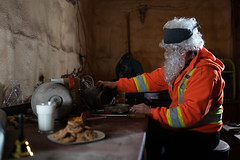
    Retrieved from “https://en.wikinews.org/w/index.php?title=A_portrait_of_Scotland:_Gallery_reopens_after_£17.6_million_renovation&oldid=4513140”
    Uncategorized

    Indonesian blackout caused by lack of generation capacity

    Saturday, August 20, 2005

    A power outage in Indonesia that left about 100 million people without electricity has caused a political crisis. The country’s state-owned energy monopoly, PLN, has not determined the immediate cause, and the country’s president has ordered the national intelligence agency and police to investigate.

    The blackout appears related to deficiencies in Indonesia’s power generation capacity.

    The power failure follows attempts to deal with the country’s growing energy crisis, including conservation and trying to allow private companies to provide energy, which was ruled unconstitutional in 2004. In January, the Indonesian government held a special energy summit to attract investment in their energy infrastructure. At the summit they set the goal of adding 22,000 megawatts to Indonesia’s present capacity of 23,000 megawatts, in order to support the country’s growth.

    The World Bank and others have warned that without more investment in the country’s energy infrastructure an energy deficit will result. However, foreign investors remain wary of investing in Indonesia. “The power outage has resulted in worries over an energy crisis which could hurt the nation’s industrial sector,” said a trader on Indonesia’s stock market.[1]

    The outage began at 10:23 a.m. local time, August 18, 2005, when power failed along the electrical system that connects Java, Bali, and Madura, causing outages in Java and Bali. Almost half of the country depends on the electrical grid that experienced failures. Some of the main lines on the grid are over 20 years old, according to PLN president Eddie Widiono.

    The blackout caused traffic jams in Jakarta, forced cancellation of several international and domestic flights at Jakarta’s Soekarno-Hatta International Airport, shut down Jakarta’s electric train service, and disrupted hospital operations. Some larger hospitals were forced to delay surgeries while many smaller hospitals could not receive patients. About 1,800 officers were called into action by Jakarta’s metropolitan police to deal with short-term problems caused by the power failure.

    Candles used in place of electric lighting started six fires in Jakarta alone.

    Mulyo Aji, a PLN official, said more power failures are likely in the future as energy demand increases, without any corresponding new supplies of electricity scheduled to come online soon.

    Retrieved from “https://en.wikinews.org/w/index.php?title=Indonesian_blackout_caused_by_lack_of_generation_capacity&oldid=4615738”
    Lawyers

    Power Of Attorney Form And Revoke Power Of Attorney

    A power of attorney is a legal document wherein one person (the Granter/Principal) appoints another person or organization to act as an agent on his or her behalf. The granter delegates his authority to the agent to perform certain acts or functions on his behalf. The person or organization you appoint is referred to as an “Attorney-in-Fact” or “Agent”. Legal will and power of attorney has a close relationship. Whenever a testator creates a Will, he definitely requires a person to enforce his Will according to his wishes. Therefore, executor works in the same way as an agent work in power of attorney forms.

    Purpose of Power of Attorney

    Coming to power of attorney, it enables a principal’s affairs to be managed by a person of their choice when they are unable to conduct them personally, such as if they are ill, traveling overseas or become mentally incapacitated. A powers of attorney will usually end either at a specified time or upon the request of the principal at any time using a power of attorney revocation and will automatically be revoked if the donor loses mental capacity. We will come to revocation shortly.

    Types of Powers of Attorney

    General Power of Attorney: This is where you appoint someone, usually for a specific period of time, to make financial or legal decisions for you.

    Health Care Power of Attorney: A Health Care Power of Attorney is a document that allows you to designate a person (an “Agent”) who will have the authority to make health care decisions on your behalf if you are unconscious, mentally incompetent, or otherwise unable to make such decisions

    Special Power of Attorney: A special power of attorney allows you to give only specific powers to the person or organization you appoint as your Agent. For example, you could authorize someone to sell a car or a house for you.

    The Pros and Cons of the Power Of Attorney

    [youtube]http://www.youtube.com/watch?v=pladteFFer8[/youtube]

    Why the document is useful

    The general power of attorney would be useful if, for example, you are selling your home and the exchange of contracts is due to take place around the time when you will be away on holiday. Then, if there are problems while you are away on holiday – e.g. a last minute amendment to what is included within the fixtures and fittings of the property – these amendments can be signed off by your ‘attorney’ under your general power of attorney. Failure to have a power of attorney in place may mean that, in this scenario, you cannot complete the paperwork in the proper form accepted by solicitors and Land Registry for a property sale even if you fully know and have agreed to all the amendments.

    Remember that in giving a power of attorney to someone, you are basically giving up all your powers in favour of your attorney. For instance, your agent has full right to agree or refuse to sign a contract on your behalf. If the agent turns out to be corrupt, then any transaction that he handles is at risk for fraud. Thus, giving that kind of power to one person can be very risky even if you plan to monitor all the transaction made in your name.

    Deciding Who to Appoint

    You need to make this decision for yourself. You can choose any adult to be your agent. You should try to appoint someone who you have grounds for believing is trustworthy and who both knows you well enough, and is objective enough, to make the decisions that are best for you.

    Powers of Agent/Attorney

    These powers usually include: Handling banking transactions Entering safety deposit boxes Handling transactions involving U.S. securities Buying and selling property Purchasing life insurance Settling claims Entering into contracts Exercising stock rights Buying, managing or selling real estate Filing tax returns Handling matters related to government benefits You also have the option to grant the following additional powers to your Agent: Maintaining and operating business interests Employing professional assistance Making gifts Making transfers to revocable (“living”) trusts Disclaiming interests (this has to do with estate planning strategies to avoid estate taxes) A principal can also limit or place conditions on how he wants his attorney/s to carry out their responsibilities.

    What are the Public Guardian’s responsibilities?

    All continuing and welfare powers of attorney must be registered with the OPG who will maintain a Public Register. The Public Guardian also has a statutory obligation to notify the appropriate local authority and Mental Welfare Commission of any welfare powers of attorney which have been registered. Once a power of attorney has been registered with this office, the Public Guardian will return the signed power of attorney and issue a Certificate of Registration to the sender. The Certificate can then be used by the Attorney immediately in the case of a continuing power of attorney if this is the Granter’s wish, or it can be kept safe until such times as the Granter has lost capacity or wishes the Attorney to act on his/her behalf. A welfare Attorney however cannot exercise any of the welfare powers granted until the Granter has lost capacity.

    Can the Power of Attorney be Revoked?

    The Granter can revoke a continuing or welfare power of attorney or any of the powers granted in it once it has been registered with the Public Guardian. The granter must give notice of the revocation in writing.

    Why Revoke a Power of Attorney Some reasons include:

    The power of attorney is no longer necessary as you are now able to act on your own behalf; You no longer trust your attorney; You have found a more suitable candidate to act as your attorney; It is no longer practical to have your attorney acting on your behalf (e.g. your attorney no longer resides in the same jurisdiction as you do); and The purpose of the power of attorney has been fulfilled and you no longer need an attorney to act for you.

    Deed of Revocation of Power of Attorney A revocation of a power of attorney is not effective against the attorney or any third party (e.g. bank) until notice of the revocation has been received by that party. Consequently, it is a good idea to have a written document as evidence of your revocation to make sure there is no doubt as to your intention to revoke the power.

    A power of attorney can be revoked at any time. And you are not required to explain why you are revoking your power of attorney.

    Effective Revocation of Power of Attorney

    Upon the signing of the Deed of Revocation, a witness shall be required to counter sign the Deed to confirm that you are the correct person and that you have chosen to revoke power of attorney that is in place. The Deed of Revocation document and copies of such must be given to the attorney and any third parties who are involved in the matter. We recommend that you make copies for this purpose to ensure the original is kept safe and cannot be misplaced.

    Net Lawman’s Power of Attorney and Legal Will Forms

    Net Lawman has various templates of power of attorney and last will and testament template. We also have forms to revoke a power of attorney whereby you will have ease of mind and can simply use our template to revoke an existing power of attorney. The Deed of Revocation document is a template that can be easily and fully edited to ensure it meets your requirements. The template has been drafted by our team of Solicitors and Barrister for reliability.

    Our templates have been designed to protect your legal rights when you need to hand over power of attorney to another or to create a legal will. You can customize the template according to your own wishes. The document available for download is written by expert team of Solicitors and Barristers to ensure your rights are being protected. Our templates have been designed to be used in Scotland, and are regularly updated to comply with domestic legislation.

    Article Source: sooperarticles.com/law-articles/power-attorney-form-revoke-power-attorney-510162.html

    About Author:

    Paul Johns working for – Net Lawman SC for providing best quality legal documents, legal agreements and free information for: power of attorney, confidentiality form and non disclosure agreements .Author: Paul Johns

    Uncategorized

    CanadaVOTES: Libertarian Kevin Stricker running in Saskatoon—Rosetown—Biggar

    Saturday, September 27, 2008

    On October 14, 2008, Canadians will be heading to the polls for the federal election. Libertarian Party candidate Kevin Stricker is standing for election in the riding of Saskatoon—Rosetown—Biggar.

    Born in Saskatoon, he graduated from the University of Saskatchewan in 2003, with a B.Sc. with Great Distinction in Computer Science; he received a University Medal in Science. Having worked for several area businesses, this is his first political run. A longtime member of Fair Vote Canada, he currently serves on the Libertarian Party’s ethics committee.

    Wikinews contacted Kevin, to talk about the issues facing Canadians, and what they and their party would do to address them. Wikinews is in the process of contacting every candidate, in every riding across the country, no matter their political stripe. All interviews are conducted over e-mail, and interviews are published unedited, allowing candidates to impart their full message to our readers, uninterrupted.

    The riding includes southwest Saskatoon and area, including rural areas Biggar, Rosetown and Delisle. First elected in 2000, Conservative MP Carol Skelton announced she would not be seeking re-election, and was shuffled out of her Minister of National Revenue and Minister of Western Economic Diversification cabinet posts.

    Winning the Conservative nomination in the riding is acclaimed Mayor of Waldheim Kelly Block, who is joined by Stricker, Amber Jones (Green), Roy Bluehorn (Liberal), Nettie Wiebe (NDP), Marcel Leon Bourassa (Christian Heritage), and independent Rick Barsky.

    For more information, visit the campaign’s official website, listed below.

    Retrieved from “https://en.wikinews.org/w/index.php?title=CanadaVOTES:_Libertarian_Kevin_Stricker_running_in_Saskatoon—Rosetown—Biggar&oldid=778333”
    Uncategorized

    On the campaign trail, December 2011

    Sunday, January 1, 2012

    The following is the second in a monthly series chronicling the U.S. 2012 presidential election. It features original material compiled throughout the previous month after a brief mention of some of the month’s biggest stories.

    In this month’s edition on the campaign trail: the campaign manager for a candidate already seeking two presidential nominations discusses the likelihood his candidate will run for the Reform Party’s nomination; a lesser known candidates forum reveals an alternative fuel possibility and concludes in a dramatic fashion; and the newly nominated candidate for the Boston Tea Party talks with Wikinews.

    Retrieved from “https://en.wikinews.org/w/index.php?title=On_the_campaign_trail,_December_2011&oldid=4641427”
    Uncategorized

    Australia: Mat Morgan, Greens candidate in South Gippsland, talks climate, tourism, and local issues with Wikinews

    Sunday, September 5, 2021

    Since June 2019, the people of South Gippsland Shire, located at the southernmost tip of Australia, have been without a local council, after a state government inquiry found “high levels of tension” within the council. Administrators were appointed by the Victorian state government in July 2019, who have governed the shire since then. However, South Gippsland’s council is scheduled to be restored with an election to be held via post from October 5-22, 2021.

    Wikinews interviewed one of the candidates standing in this election, Mat Morgan. He is running as a candidate in the Coastal-Promontory Ward, and is endorsed by the Australian Greens. The Coastal-Promontory ward covers towns such as Venus Bay, Waratah Bay, Yanakie, Foster, Port Welshpool, and Toora, and elects three councillors to the South Gippsland Shire Council.

    Retrieved from “https://en.wikinews.org/w/index.php?title=Australia:_Mat_Morgan,_Greens_candidate_in_South_Gippsland,_talks_climate,_tourism,_and_local_issues_with_Wikinews&oldid=4645599”